
The Home Load: Why Your Home Feels Overwhelming
What should our homes be doing for us?
In the work I do with interiors and the nervous system, one of the biggest challenges I face is that so much of this happens in the background, in systems we're not consciously aware of. If something's off but it's not right there in front of your conscious mind, it's easy to miss, especially when you don't know what to look for.
This article tells you what to look for and why.
Why We Don’t Know What To Look For
In the modern world, there's so much noise around us that we're often too distracted to notice the noise within us.
If you've never paused to listen to your breathing, you might not realize you hold your breath a little when you walk into a messy room. If you don't recognize emotions as signals from your body, you can't hear what they're telling you about your environment. If you've relied on over-functioning to override your nervous system, you're probably missing the cues telling you to pause and rest. If you never get a break from sensory and cognitive demands, you never get the chance to actually process them.
To someone just entering this conversation about the way your interior environment communicates with your inner environment, some of this might sound abstract, or even a little woo. It’s not. It’s based in neuroscience and environmental psychology, and it’s supported by research. What it really is, however, is simple wisdom that we have lost touch with over time.
We're plenty comfortable saying "I don't feel good" or "I feel great!”, but when it comes to "something feels off" or "this feels out of alignment with me”, we tend to pull back. Maybe that’s because we don’t really know what to do about it.
The way your environment affects you isn’t abstract, though. It’s real, and it matters a lot. Every little reaction you have to your environment is linked to significant loads that you carry every single day. Your home can either add to those loads or help lighten them. If you pay attention to the little reactions, and you attune to what they’re caused by, you’ll know exactly what needs to be changed.
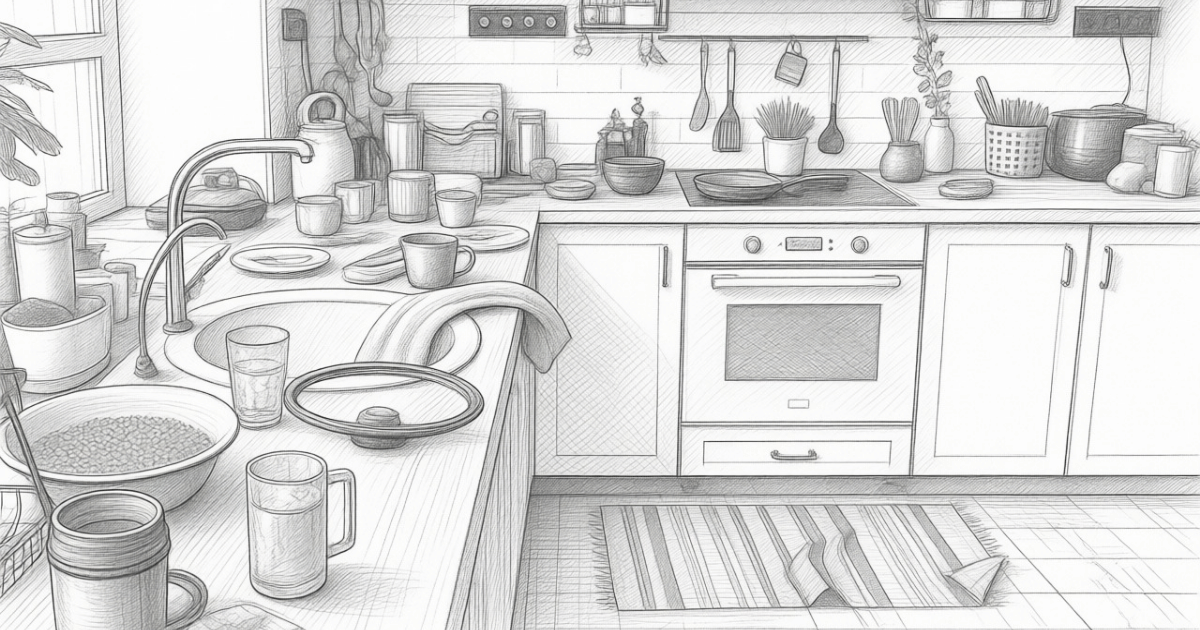
The Four Loads
There are four key loads we manage at all times, and each one shapes how we feel and function.
Let's walk through what they are, what they look like in the home, and how you can start to lighten them so you can feel and function better.
1. The Cognitive Load (Mental)
The cognitive load is the easiest to recognize, since it's tied to the never-ending to-do list most of us carry. It's the mental effort of managing decisions, visual and informational noise, and uncertainty in your space. These are things you have to track, decide on, or process. Like open browser tabs, even when you're not actively thinking about them, they're still running in the background, draining your battery.
Any planning or management in your home adds to your cognitive load:
The piles that represent unmade decisions, uncertainty, or dread.
The planning required for meals, appointments, and all the other scheduling logistics.
The abundance of stuff that needs tidying, cleaning, or fixing.
The systems you hold in your head because nothing is labeled or clarified.
The nonstop errands you have to squeeze into limited time.
The tasks that fall to you, or that you have to find someone else to do.
The choices you have to make before you've even had your first sip of coffee.
You can notice your cognitive load by listing every single thing that needs to be done. You can lighten it by outsourcing what you can, decluttering so there's less to manage, and simplifying your systems. There's a good chance some of what's demanding your mental energy doesn't need to be there at all. Let it go.
» Anything that demands your time and attention needs to be vetted: Does it really need doing? Do I need the one to be doing it?
2. The Emotional Load (Psychological)
The emotional load is tied to how your home, and the relationships within it, make you feel. It's the weight of managing stress, conflict, guilt, resentment, and shame, and it's rooted in the need to feel safe in your own space. It's less obvious than the cognitive load, but just as present.
Any feeling, big or small, adds to your emotional load:
The spaces you avoid because of dread, overwhelm, or a sense of lack.
The clutter that fills you with shame if someone unexpected sees it.
The items you keep out of guilt or obligation rather than love.
The unfinished projects that quietly make you feel like a failure.
The conflict that keeps happening in the same room, over the same mess.
The reminders of grief left behind from a hard season of life.
The photos of memories that sting because they highlight how much you've changed.
You can notice your emotional load by paying attention to what frustrates you, and what you avoid whenever you get the chance. You can lighten it by removing items that carry negative emotion, practicing acceptance where things can't be changed, and facing what you'd rather avoid. You have full permission to make changes that genuinely feel good.
» Anything that feels bad should be questioned: Why does this feel bad? What would it take to make this feel better?
3. The Physical Load (Biological)
The physical load doesn't get talked about as much, but it matters just as much as the others. It covers anything tied to your body's needs — sleep, movement, sensory input, hormones, developmental stages, and physical limitations. It's about how your home supports, or fights, your body's actual functioning.
Any friction in how your body moves through your home adds to your physical load:
The sensory overwhelm from visual clutter, background noise, too much stimulation.
The eye strain from poor lighting or text too small to read comfortably.
The extra effort it takes to work around an inefficient layout.
The aching back from bending awkwardly to reach your low pantry shelf.
The stiffness from sitting in an uncomfortable chair.
The chronic fatigue from not sleeping well in your stuffy bedroom.
The exhaustion from never fully recovering.
You can notice your physical load by tuning into your five senses. You can also tune into physical clues like a tight chest, clenched fists, or a long sigh. You can lighten it by accommodating what your body actually needs, prioritizing sensory comfort, and trying different variations until something truly feels easier. If it's hard, annoying, or painful, it's not working. Not everything in life needs to be easy or comfortable — but in your home, you have the chance to use ease and comfort as support.
» All discomfort is worth investigating: Where’s the friction? What do I need to happen in this space?
4. The Identity Load (Performance)
The identity load is nearly invisible to most of us, but it plays a real role in how we feel and function. It's about how your home reflects — or fails to reflect — who you are, who you want to be seen as, and the external validation or judgment tied to that. It's the gap between self-perception and desired perception, and it shifts with life stages, values, culture, and outside pressure.
Anything in your home that doesn't feel aligned with who you are adds to your identity load:
The decor you chose to impress someone, rather than to support how you actually live.
The trends you tried but never really loved.
The photos on the wall that felt like a performance when you took them.
The style that doesn’t actually reflect your personal style.
The high-maintenance materials in a home for people who don't enjoy maintaining things.
The furniture you don't even like, but keep because your in-laws gave it to you.
The artwork that looks nice enough, but if you're honest, you don't enjoy looking at.
You can notice your identity load by pausing to ask whether your home actually reflects who you are. It's okay to want your home to perform a little for guests, but when it's designed entirely around others' judgment, the load increases. It starts to feel inauthentic. It stops feeling like your home. 🔑
Yes, if you live with others some compromise will be made so everyone feels at home, but that doesn't mean forgoing your identity in the process.
» Everything in your home should be aligned with who you actually are: Does this reflect who I am and who I want to be? Why do I value the judgement of others over my own?
The four loads interact with each other.
Perhaps there’s a room in your house that has a lot of unmade decisions (cognitive), which have become clutter that makes you feel shame (emotional), but you haven’t made those decisions because you have been dealing with lower energy than usual (physical). If you were to look closely, a lot of those decisions wouldn’t need to be made if you gave yourself permission to just be yourself (identity). Maybe you’ve been showing up in the world as a high performer and taking on tasks to prove it, but in reality you’re a pretty laid back human who enjoys simplicity.
Any combination of these loads can exist, which is one of the biggest reasons WHY people don’t know why they don’t love their home.
You can never eliminate all the loads, nor should that be something to aspire to. After all, our cognitive, emotional, physical, and identity loads are all part of what gives life meaning, so long as they are aligned with who we are and what we need. What we can do, however, is lighten these loads so they are more manageable and less overwhelming.
In all of this, your home plays a very active role.
It’s either adding to what you're carrying or carrying some of it for you, and it’s always interacting with your nervous system. This is the exact meaning behind your home as a resource for living a better life. When we work together, we explore your home loads and create strategies to lighten them.
You have the ability to make meaningful changes on your own. All it takes is small, intentional shifts. One drawer, one room, one honest look at what you're keeping (and why) can signficantly lighten what you carry every day so you can feel and function better.
3 Questions To Help You Reflect On The Loads You’re Carrying:
Which of the four loads feels heaviest for you right now — cognitive, emotional, physical, or identity?
Walk through your home in your mind. Where do you feel the most ease? Where do you feel the most friction?
If you could lighten just one load this week, what's one small change you could make to start?